Large Venues London: What the 'Best Venue' Lists Miss
There are 1,700+ large venues in London, and 'best of' lists won't find you the right one. Our venue team shares the real trade-offs to consider.
If you’ve been asked to organise your company’s awards dinner, annual conference, product launch, or another type of corporate event, you’ve probably already searched for the best large venues London has to offer. Now you have forty tabs open, and every venue describes itself as iconic.
We run one of the largest single-space venues in the capital, here in Battersea Park, and planners often enquire with a shortlist built on a single question: “Which venue is best?” But with more than 1,700 large venues across London, ‘best of’ lists measure popularity and marketing budgets rather than whether a space is right for your event.
So this article takes a different approach. Rather than another ranked list, we’re sharing what our events team wishes every enquiry already knew, including the trade-offs to consider when looking for large London event venues, the capacity traps that catch first-time planners, and what hosting 10,000-visitor exhibitions and 3,000-guest awards nights has taught us.
Why 'best' is the wrong question for large venues in London
The best large event venue in London is the one whose trade-offs match your event. This includes guest numbers in your layout, hire model, and production capability against your dream format. No single venue tops that list for every event! Which is why ranked lists so rarely help.
Venue directories typically rank by commercial relationships and search demand, so the venues that appear everywhere tend to be the ones that advertise everywhere. There’s nothing wrong with this, but it does mean a top-ten article should be your starting point at most.
More importantly, ‘best’ simplifies multiple variables. A space that’s perfect for a 2,000-cover gala dinner can be entirely wrong for a 1,500-delegate conference. A better question then, is which trade-offs are you willing to make? At this scale, every venue has potential trade-offs.
Four trade-offs for evaluating large venue hire
After hundreds of large-scale events at Evolution London, we’d argue almost every venue decision comes down to four considerations.
1. Scale vs atmosphere
Big rooms can feel empty at the wrong guest number, which can directly impact atmosphere. The real test of a large venue is whether it can be transformed into the right layout and size based on your capacity.
For example, when the Inspiring Stories Showcase brought a 200-guest, theatre-style event to a space that seats 3,500, we focused on careful zoning, draping and lighting to avoid empty space. Ask any large venue you visit to show you photos of their smallest event, or an event that directly matches your event type and preferred format.
2. Character vs canvas
Heritage venues give you built-in gravitas, and for some events that’s exactly right. The trade-off is fixed constraints, such as pillars that interrupt sightlines, or protected features you can’t rig from, or early curfews, or limited access times once spaces have closed to the public, or approved-supplier lists you can’t change.
Blank canvas venues hand you total control of the brand experience, but the design job needs attention on both yours and the venue manager’s side.
3. Control vs certainty
In other words, dry hire vs full service.
If you have an experienced production agency and a clear creative vision, dry hire offers freedom to dress a large space how you’d like. On the other hand, if you’re missing expertise, or this is your first major event, and it simply cannot go wrong, the certainty that comes with full service event management is more valuable.
4. Headline price vs total cost
Across the industry, dry hire extras (power, furniture, technical kit, security, cleaning) commonly add 20 to 30% to the base fee. Build and derig days are often charged as additional tenancy, and “AV included” can mean a house PA system rather than awards-show production. Compare venues on the total delivered cost, never the headline figure, which is often the one listed on venue directories.
The number on the website is not your number
To compare large London venues on capacity, ask each one for its capacity in your layout, with production in the room. Any venue quoting a single figure is quoting its most flattering configuration.
The same space produces wildly different numbers depending on the format. Here at Evolution London, our 5,500m² of unimpeded floor space holds:
- 5,000 for exhibitions and trade shows
- 4,000 for standing receptions
- 3,500 theatre-style
- Up to 2,000 for seated dinners
That’s a 3,000-person swing in one venue, before production enters the conversation. And production always enters the conversation: a stage and screen at awards scale, camera positions, production desks, catering stations and accessible circulation routes all consume floor space. A full show build can change the footprint of hundreds of dinner covers.
You can explore our space and specifications with those questions in mind.
What hosting large-scale events have taught us
Gala dinners and award ceremonies: The constraint is the kitchen
For gala dinners and corporate award ceremonies, shortlist any venues that can serve 1,000-plus covers hot, with dietaries considered, together, and on time because at such a large scale, catering logistics will affect the guest experience more than décor does.
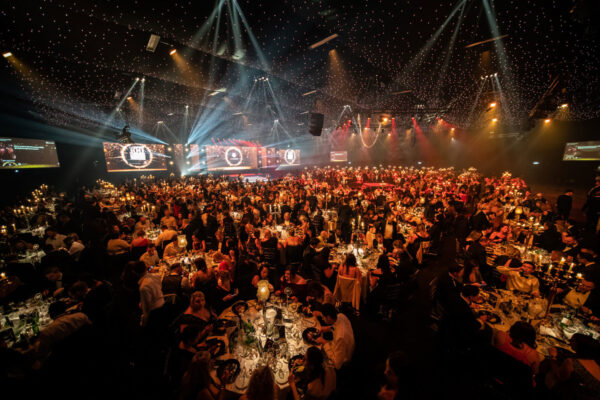
When we hosted the L’Oréal Colour Trophy grand finale, 1,393 guests sat down alongside a full show production, and we planned the service windows as precisely as the running order. Similarly, the Best Companies Awards welcomed 3,000 guests across two consecutive evenings, so our space and our catering partner, Moving Venue, had to meet this demand.
Want to raise the stakes even higher? Media Fight Night 2025 placed a boxing ring at the centre of a fine-dining event for 1,800 guests and raised £350,000 for charity. Layouts like this require the venue, caterer and production team to plan the room together. So when you’re comparing venues for a banquet or ceremony, ask whether catering is prepared on-site, how many covers per service window, and where the service routes run.
Conferences with breakout rooms: Prioritise zoning over square footage
For conferences, a single divisible space is better than a warren of fixed rooms, because you design the delegate flow rather than being forced to work around rigid structures. Plenary, breakouts, catering and sponsor space can sit within one footprint, and delegates move between them in minutes, without worrying about getting lost between lifts and corridors.
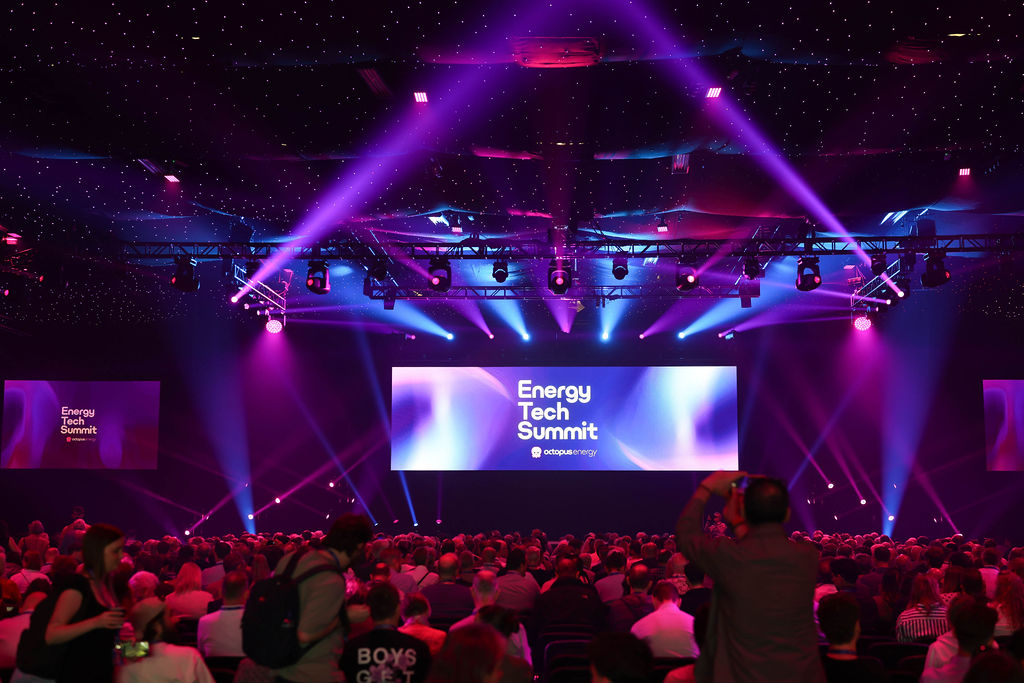
Adobe MAX ran exactly this way at Evolution London. The event hosted 1,500 delegates across a zoned plenary, breakout and networking layout in one room. Meanwhile, the Octopus Energy Tech Summit began life as a 400-person conference and grew into a 2,500-attendee experience in six weeks. Only a blank canvas space with production under the same roof makes that kind of scale-up possible — a fixed-room venue simply has no more rooms to give.
Remember to consider acoustics between zones, too. Ask how a venue separates sound, because the seemingly small matter of a keynote talking over a workshop ruins the experience.
Lastly, if your attendance forecast has potential to grow year after year, choose a venue that can grow with it. We’ve written more about this in our guide to scaling conferences in London venues.
Exhibitions and trade shows: The event is won in the build days
For exhibitions and trade shows, judge large London venues on their logistics propositions, such as floor loading, vehicle access, power distribution and tenancy days. Your exhibitors’ experience determines whether they rebook, and visitors only ever see the result, not the work behind it.
The Decorative Fair returns to our location in Battersea Park three times a year, bringing more than 130 exhibitors and over 10,000 visitors each edition. Vehicles arrive on the hour, stand builds run in sequence across the tenancy days, and the derig finishes to a hard deadline. When you tour an exhibition venue, be sure to ask about the loading bays and access times.
Hybrid and flexible-format events: Design for the camera and the room at once
Hybrid events can be challenging because an excellent broadcast needs controlled lighting and clean sightlines, while the live audience needs energy and proximity.
Where can you rig, what bandwidth is available for streaming, and where will the cameras live without blocking paying guests? A blank canvas space with an 8-metre ceiling height and full in-house production makes those answers considerably easier. The infrastructure is designed around your format instead of the other way round.
Dry hire in London
Plenty of large London venues offer dry hire, including Evolution London, but dry hire only suits some planners and at Evolution, for example, you do need to have a minimum production for your event.
Dry hire is the right call when you have an experienced production agency behind you, a creative concept that needs a blank room, or a recurring event with established corporate events suppliers. In these cases, paying for space alone and controlling everything else is efficient and liberating.
However, it’s not a cost-saving strategy for inexperienced planners. The coordination burden of power, rigging, furniture, catering, security, and insurance compliance across multiple suppliers is the real cost, and it lands squarely on your shoulders.
In-house production and catering under one contract gives you a single accountable team, and people who have rigged that exact ceiling and served from that exact kitchen hundreds of times.
Our position is deliberately both. The Evolution London event space serves as a blank canvas for agencies that bring their own teams, and as a full-service venue with in-house staging, AV, and catering for teams that want one partner.
The London large-venue calendar
Autumn awards season and December book early, and within those months, Wednesdays and Thursdays go before any other night, because midweek has become the default for corporate events.
Lead times reflect that. For peak dates, 6 to 12 months ahead is realistic, and the most sought-after slots go earlier still. Booking at eight weeks or sooner isn’t impossible, but your options narrow to whatever is left, and it’s harder to achieve complex production.
If your event doesn’t need to sit in awards or the festive season, moving it between January and April is the single easiest budget decision you’ll make.
What a good event enquiry looks like
Three things enable us to give a more detailed answer on the first call:
- Your guest numbers (invited versus expected are different figures)
- Your event’s one non-negotiable
- Your production assumptions, even rough ones.
- The exact date or flexibility
- Your budget
And since we’ve spent this article urging you to interrogate venues, here are the red flags to watch for in our own industry:
- Vague inclusions
- Capacity quoted without a floor-plan conversation
- Any version of “we’ll confirm that later” on costs
The right venue is a set of trade-offs you choose
You’ll never find the best large venue in London, because it doesn’t exist. What does exist is a venue whose trade-offs match your event, chosen deliberately, with your numbers, your format and your non-negotiables in front of you. Get that decision right, and everything from production to guest experience will be easier.
If you’re weighing up those trade-offs now, we’re happy to talk them through with you. Bring us your numbers, your format and your one non-negotiable, and our team will tell you plainly what Evolution London can do, and show you the events that prove it.
Contact Evolution London
FAQs about large venues in London
What are the best large event venues in London?
There’s no universal answer. The best large venue is the one whose location and travel accommodation requirements, capacity in your layout, hire model and production capability match your event. Start from your guest numbers, format and non-negotiables, then compare venues on total delivered cost and operational track record rather than rankings.
What are the best large venues in London for gala dinners?
Shortlist venues that can serve your full guest count hot and together, with on-site kitchens or dedicated catering partners, and proven service at scale. Evolution London seats up to 2,000 for dinner and has delivered events including the 1,393-guest L’Oréal Colour Trophy and Best Companies awards for 3,000 guests across two evenings, as well as Hospitality Rocks with 2,100 attendees.
Which large London venues offer dry hire options?
Several of London’s blank canvas spaces offer dry hire, Evolution London among them, but note that we have a minimum production package. Dry hire suits teams with an experienced production partner; if you’re planning your first major event, a venue offering both dry hire and full in-house production lets you choose the right level of support.
Do large London venues include staging and AV?
“Included” covers a wide spectrum, from a basic house PA to full show production. Ask specifically what’s in the hire fee, what’s charged as extra, and whether the venue delivers production in-house or through third parties. Evolution London provides in-house staging, AV and technical production designed around each event.
How far in advance should you book a large venue in London?
For peak dates — June to December, especially midweek — book 6 to 12 months ahead. Off-peak months such as January to March offer more availability and better commercial terms. Complex productions benefit from longer lead times regardless of season.
How much does it cost to hire a large venue in London?
Costs vary widely with date, tenancy length and hire model, so compare total delivered cost rather than headline fees. Dry hire looks cheaper, but extras commonly add 20 to 30%, plus charged build days. Ask every venue for a full breakdown including tenancy, power, security and staffing. Professional tip: If you know you might want to book for multiple years, ask about a multi-year deal.